When planning underground utility installation, the choice between directional drilling and traditional open-cut trenching significantly impacts your project budget. While trenching may appear cheaper initially, a comprehensive cost analysis often reveals directional drilling as the more economical choice.
Understanding the Two Methods
Traditional Open-Cut Trenching
- Excavating a trench along the entire utility path
- Installing pipe or conduit in the open trench
- Backfilling and compacting soil
- Restoring surface conditions
Horizontal Directional Drilling (HDD)
- Drills a pilot bore underground
- Reams the bore to required size
- Pulls utility pipe through completed bore
- Leaves surface largely undisturbed
Direct Equipment Costs
Trenching Equipment Investment
- Excavator or backhoe: 50,000–200,000 (purchase) or 300–800/day (rental)
- Dump trucks for spoil hauling: 40,000–150,000 or 250–500/day
- Compaction equipment: 15,000–50,000 or 150–300/day
- Shoring and safety equipment: 10,000–30,000
- Traffic control equipment: 5,000–15,000
Typical Daily Rate: 1,200–2,500 for complete trenching spread
Directional Drilling Equipment Costs
- HDD rig (sized for project): 150,000–500,000 or 800–2,000/day
- Mud mixing and recycling system: 30,000–80,000 or 200–400/day
- Locating equipment: 10,000–25,000 or 100–200/day
- Support equipment: 15,000–40,000 or 150–300/day
Typical Daily Rate: 1,250–2,900 for complete HDD spread
Initial equipment costs appear similar, but project duration creates significant differences.
Labor Cost Analysis
Trenching Labor Requirements
Crew: equipment operators (2–3) at 40–60/hour each; laborers (4–6) at 25–40/hour; utility locator at 35–50/hour; safety/traffic control (2) at 30–45/hour; supervisor at 50–75/hour.
Average Crew Cost: 350–550 per hour. Production Rate: 100–200 linear feet per day.
Directional Drilling Labor Costs
Crew: HDD operator at 45–70/hour; locator/tracker at 40–60/hour; ground crew (2–3) at 30–45/hour; mud technician at 35–50/hour; supervisor at 50–75/hour.
Average Crew Cost: 250–400 per hour. Production Rate: 200–500 linear feet per day.
Site Restoration Costs
This is where directional drilling shows its greatest advantage.
Trenching Restoration Expenses
Immediate: Backfill material 15–30 per cubic yard; compaction and grading 5–12 per linear foot; temporary surface restoration 8–15 per linear foot.
Permanent: Asphalt replacement 8–15 per square foot; concrete replacement 12–25 per square foot; landscape restoration 5–20 per square foot; utility coordination/protection 2,000–10,000 per crossing.
Average Restoration Cost: 25–60 per linear foot for developed areas.
HDD Restoration Costs
Entry pit restoration 500–1,500; exit pit restoration 500–1,500; surface cleanup 200–800; minor landscape touch-up 300–1,000.
Average Restoration Cost: 3–8 per linear foot.
Example: 500-foot installation in asphalt — trenching restoration 12,500–30,000 vs. HDD restoration 1,500–4,000. Savings: 11,000–26,000.
Time-Based Cost Factors
Project Duration
Trenching, 500 feet: 3–5 days. Mobilization 0.5 day; utility locating 0.5 day; excavation 2–3 days; installation 0.5 day; backfill/compact 1–2 days; initial restoration 0.5–1 day.
HDD, 500 feet: 1–2 days. Mobilization 0.5 day; pilot bore 0.5–1 day; reaming and installation 0.5–1 day; demobilization 0.25 day.
Time Savings: 2–3 days (40–60% reduction).
Indirect Time Costs
Business disruption: trenching 2,000–10,000/day on major thoroughfares vs. HDD 500–2,000/day. Traffic control: trenching 500–1,500/day vs. HDD 300–800/day. Permit holding: trenching 200–500/day vs. HDD 150–300/day.
Environmental and Regulatory Costs
Trenching: Erosion control 1,500–5,000; stormwater management 1,000–4,000; soil disposal 500–3,000; environmental monitoring 500–2,000. Permits: excavation 500–2,000; traffic control 300–1,500; environmental 500–3,000; inspection fees 500–1,500.
HDD: Drilling fluid management 800–2,500; monitoring 300–1,000; cleanup 200–800. Permits: boring 400–1,500; right-of-way 300–1,000; environmental review 300–1,500.
Real-World Cost Comparison
Scenario 1: Urban Street Crossing (500 feet)
Trenching: Equipment $2,500 × 4 days = $10,000; labor $450/hr × 32 hrs = $14,400; restoration $25/LF × 500 = $12,500; traffic control $1,000 × 4 days = $4,000; permits and fees $4,000. Total: $44,900
HDD: Equipment $2,200 × 2 days = $4,400; labor $350/hr × 16 hrs = $5,600; restoration $5/LF × 500 = $2,500; traffic control $600 × 2 days = $1,200; permits and fees $2,500. Total: $16,200
Savings with HDD: $28,700 (64%)
Scenario 2: River Crossing (300 feet)
Trenching (open cut): Not feasible without extensive environmental permits. Dewatering 15,000–30,000; temporary bridge/access 25,000–50,000; environmental mitigation 20,000–40,000; timeline 3–4 weeks. Estimated Total: 80,000–150,000
HDD: Equipment $3,500 × 3 days = $10,500; labor $400/hr × 24 hrs = $9,600; permits $5,000; environmental compliance $3,000. Total: $28,100
Savings with HDD: 51,900–121,900 (65–81%)
Hidden Costs to Consider
Trenching: Rock excavation +50–150 per cubic yard; groundwater dewatering +5,000–20,000; utility conflicts +2,000–10,000 each; contaminated soil +100–500 per ton. Liability: utility damage 10,000–100,000+ per incident; property damage 5,000–50,000; injury claims deductible 5,000–25,000.
HDD: Difficult geology +10–30% equipment time; inadvertent returns +1,000–5,000 cleanup; failed bore (rare) +5,000–15,000 to re-drill; downtime +500–2,000/day; additional mud +500–2,000; extended locating +200–600.
Making the Economic Decision
When Trenching Makes Sense
Very short runs (<100 feet); open, undeveloped areas; shallow depth requirements; very large diameter installations (>48 inches); rocky conditions unsuitable for HDD.
Example: Rural water line in open field, 150 feet, 6-inch diameter — trenching $3,500 vs. HDD $4,800. Trenching saves $1,300.
When HDD Provides Better Value
Urban/developed areas; road, railroad, or waterway crossings; environmentally sensitive areas; congested utility corridors; time-sensitive projects; situations requiring minimal disruption.
Example: Gas line under state highway, 400 feet, 4-inch diameter — trenching $45,000 vs. HDD $18,500. HDD saves $26,500.
A Note on Gravity Lines
HDD cannot hold grade, so for gravity sewer and storm installations the right trenchless comparison is usually auger boring or jack and bore rather than HDD.
Conclusion: Total Cost of Ownership
Directional drilling typically costs 30–70% less than trenching in urban environments, road crossings, developed properties, and environmentally sensitive areas. For installations exceeding 200 feet in developed areas, HDD generally provides lower total project cost, faster completion, reduced liability exposure, better customer satisfaction, and fewer permit complications.
Ready to Explore Directional Drilling for Your Project?
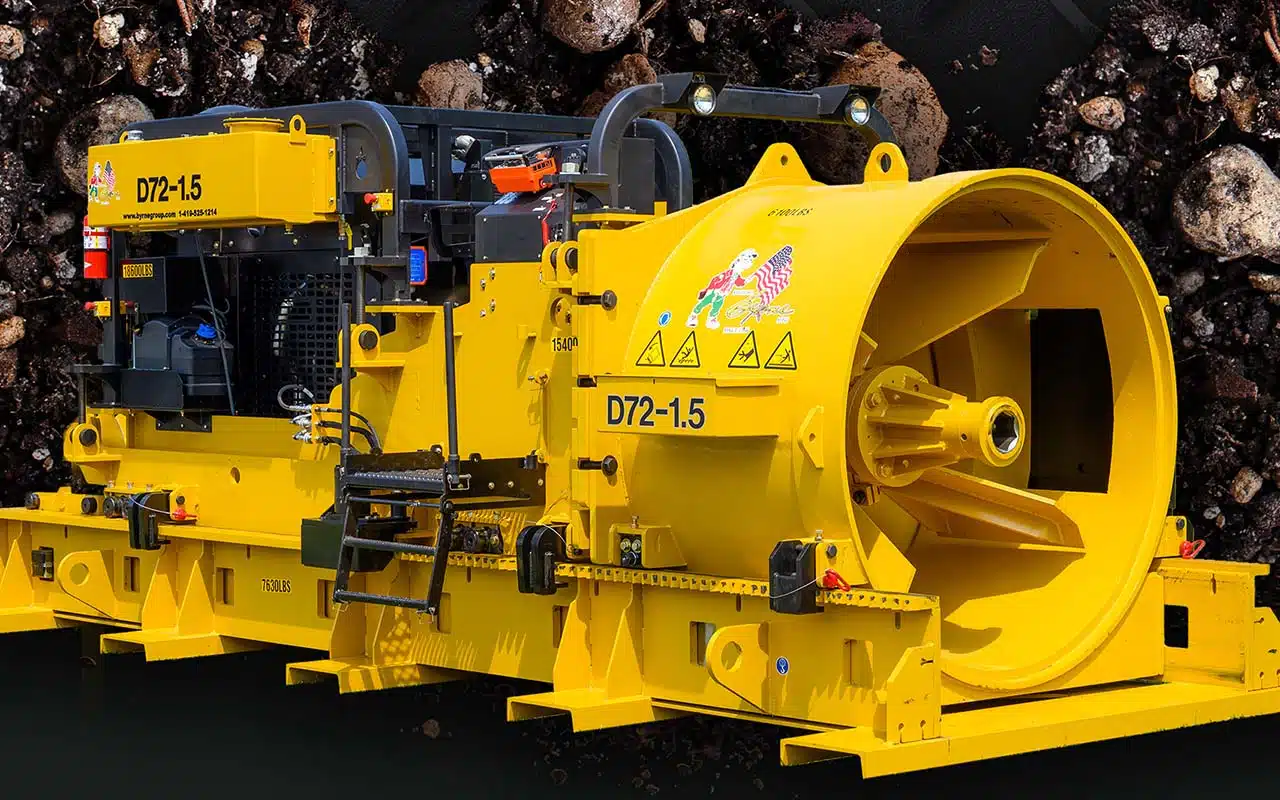
Byrne Group manufactures auger boring equipment and horizontal directional drilling products. Our engineering team can help you evaluate the most cost-effective approach for your specific project. Contact us for a detailed cost analysis.